The Real AI Opportunity in Healthcare
Healthcare sits in a peculiar position among industries: it is simultaneously one of the most important sectors in the US economy and one of the most resistant to software.
This is part of a 4-part series exploring where AI is impacting major industries that power NYC.
Healthcare sits in a peculiar position among industries: it is simultaneously one of the most important sectors in the US economy and one of the most resistant to software. The US spent $5.3T on healthcare in 2024,18% of GDP. Yet researchers at Harvard, Stanford, and Penn estimate that between a fifth and a quarter of every healthcare dollar goes to administration rather than patient care, a ratio that hasn't meaningfully changed in thirty years.
In an industry with such gravity and so much administrative waste, AI may be the vector by which software can finally “eat” healthcare.
New York offers a good window into that change. NYC Health + Hospitals is the largest public health system in the country. NYU Langone, Mount Sinai, and Northwell are among the most influential health systems in the world — and all three are already putting AI into production:
- Mount Sinai is rolling out ambient AI documentation system-wide via Microsoft Dragon Copilot
- Northwell is deploying Abridge's ambient AI platform across all 28 of its hospitals
- NYU Langone has built a private generative AI environment with over a thousand clinicians already using it
What makes this moment different from prior waves of healthcare software is the capability. LLMs can now listen to a patient encounter and produce a clinical note, process a denial and draft an appeal, and read a claims file to catch errors before submission, among other things.
As a NYC-based venture firm deep in enterprise technology since 2013, here's what we're seeing.
The Pain Points
A few areas where AI can have an immediate impact stand out:
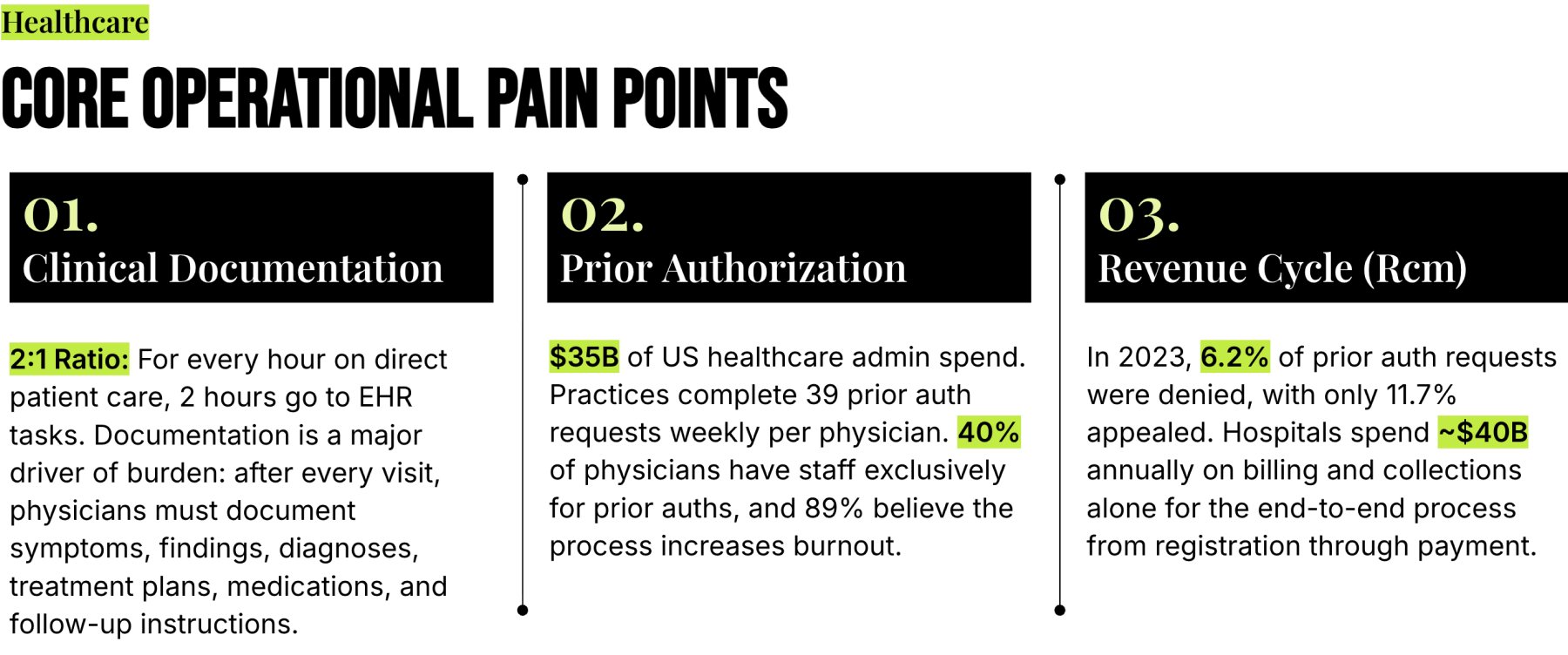
- Clinical Documentation: Studies have shown that for every hour primary care physicians spend on direct patient care, 2 hours go to EHR tasks. Documentation is a major driver of this burden: after every visit, physicians must document symptoms, findings, diagnoses and treatment plans, medications prescribed, and follow-up instructions.
- Prior Authorization: This process accounts for $35B of healthcare administrative spend in the US alone. Practices complete 39 prior authorization requests weekly per physician, 40% of physicians have staff that exclusively work on prior authorizations, and 89% of physicians believe the process somewhat or significantly increases physician burnout.
- Revenue Cycle Management (RCM): Submitting a prior authorization request doesn’t guarantee its approval. In 2023, 3.2 million of 50 million prior authorization requests were denied (6.2%), and 11.7% of the denials were appealed. That cycle is the territory of revenue cycle management: the end-to-end process, from patient registration and eligibility verification through coding, billing, claims management, denial resolution, and payment collection. Hospitals and health systems spend ~$40B annually on billing and collections alone.
Where AI can help
Several companies are already applying AI to these workflows:
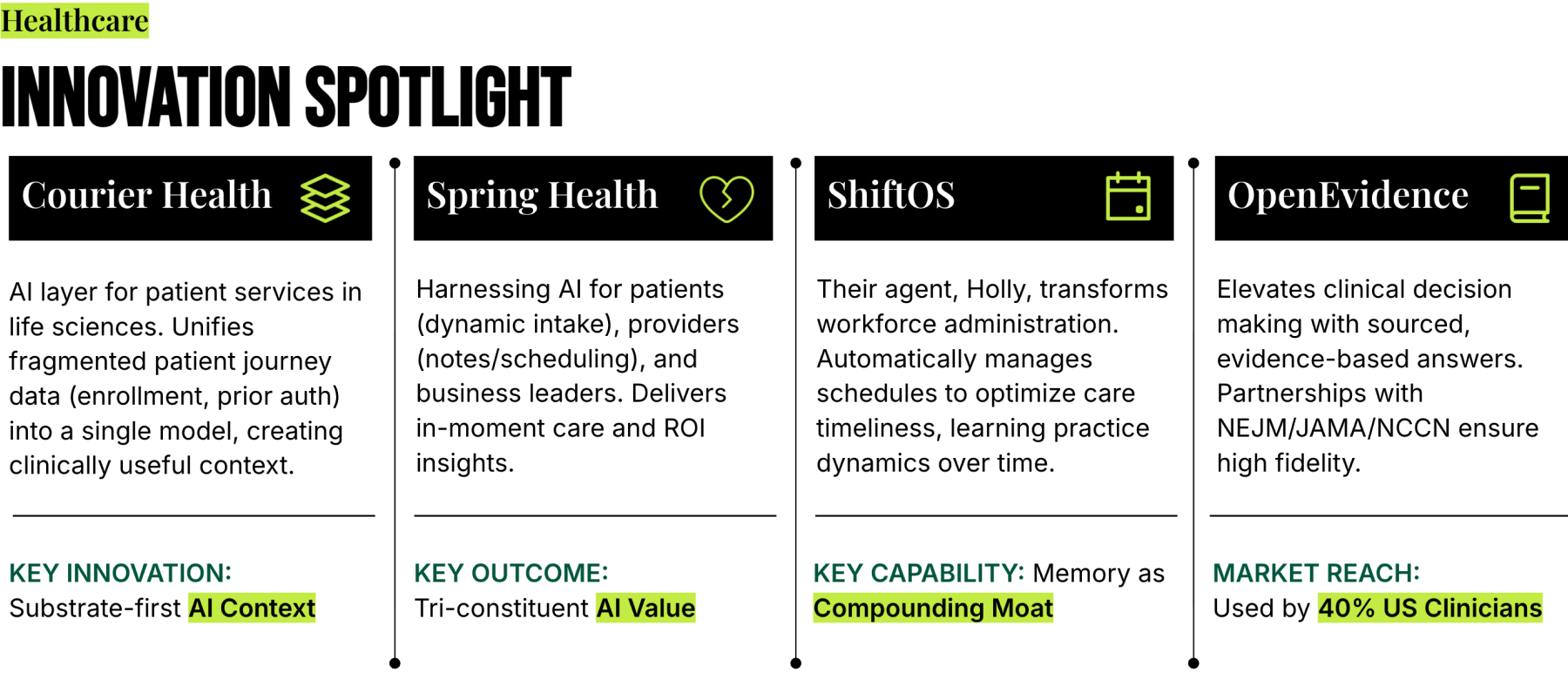
- Our portfolio company Courier Health is building the AI layer for patient services in life sciences. Their platform unifies the fragmented data that accumulates across the patient journey (enrollment, prior auth, specialty pharmacy coordination, adherence) into a single patient-centric data model, creating the perfect conditions for AI to be clinically useful and operate with full context Use cases include context-rich patient summaries that help case managers get up to speed in seconds or automated workflows that handle tasks like enrollment and scheduling without human intervention. The core insight is that AI in patient services is only as good as the data substrate beneath it; Courier Health built the substrate first, and the intelligence on top compounds from there.
- Our portfolio company Spring Health is harnessing AI in service of three core constituents: patients (members), providers, and business leaders. For patients, this means dynamic intakes, smart summaries, and in-the moment care to keep them engaged and get connected to the right provider faster. For providers, it’s generating clinical notes and streamlining scheduling. For business leaders, this takes the form of AI-powered insights and visualizations that make it easier for stakeholders to track ROI.
- Our portfolio company ShiftOS recently released Holly, an agent transforming workforce administration. The agent books, confirms, and adjusts work schedules automatically, optimizing for the timeliness of care that patients get. Memory is a compounding moat for agents at the app layer; over time, Holly builds a deeper understanding of a practice’s scheduling constraints, demand patterns, unspoken rules, and interpersonal staff dynamics, leading the scheduling to get better and better over time.
- Abridge, Ambience, Suki, Nabla, and others are automating clinical note-taking. Abridge’s documentation engine combines a medically tailored speech recognition system and a note generation system. The speech recognition system takes raw clinical audio and produces a transcript of the interaction, and the note generation system uses the transcript to produce a draft of clinical documentation.
- OpenEvidence is building AI that elevates clinical decision making. By pairing LLM technology with content agreements with NEJM, JAMA, NCCN, and other notable publications, the platform is now used daily by 40% of clinicians in the US and across more than 10,000 hospitals and medical centers worldwide.
Things To Keep In Mind
- Healthcare Will Always Be Supply-Constrained: no matter how good AI gets at understanding medical literature or diagnosing disease, the paramount constraint on care delivered will always be the number of people who can go through the 10+ years of school needed to become a physician. Unlike other industries with less of a barrier to entry to practicing (ie many great software engineers never obtained a CS degree), healthcare is dependent on trained professionals that AI will never replace. This thoroughly drives the form factor of AI adoption: being a true accelerant and complement of human practitioners rather than a force for substitution.
- Regulatory Approval and Clinical Validation: Drug discovery timelines are compressing, but the FDA approval process is not, and for good reason. AI can surface a promising compound in 18 months; getting it through Phase I, II, and III trials still takes a decade and costs billions. The bottleneck has shifted upstream without eliminating the downstream one. What does this mean for companies selling into life sciences and pharma? Software consumption follows business activity: expect slow sales cycles, but larger contracts when a procurement decision is made.
- Ethical Concerns: healthcare is an interesting industry in terms of the gravity of decisions made in the arena. For a practitioner working with a patient, a nontrivial proportion of the decisions are life-or-death judgements! In these cases, it’s important to think about how much technology should be relied upon in the decision process. Not touching it is likely suboptimal, but at the same time, outsourcing significant decision compute to these imperfect, stochastic systems in such high-risk situations may not be the smartest move.
Healthcare may be the ultimate stress test for AI in the enterprise. An industry where the software spend to revenue ratio has been an outlier low, AI might just be the moment where software can finally break in. What stands in the way is a uniquely difficult combination: entrenched administrative complexity, an integration surface fragmented across dozens of systems, and an error cost profile where the stakes are measured in patient outcomes, not just dollars. The companies that will define this space are the ones that figure out how to take workflows that are slow, expensive, and frustrating for everyone involved (patients, providers, and payers alike) and make them fast, reliable, and actually worth trusting. AI won't replace the humans at the center of care delivery, but it will be the force that finally lets them spend their time on what matters. We're watching closely.